Cash flow
The real price of getting paid early
The invoice is fine. The client is fine. They just pay at 60 days, and your rent is due in 12. Then an ad tells you you can "get paid today" by selling the invoice, or the client's portal offers to pay you next week if you'll take a little less.
Both are the same trade: less money, sooner. Sometimes that's the right call. But the price is almost always shown as a small, friendly percentage, and it only makes sense once you turn it into what it really is, a yearly rate. Here's how to do that, what the law now makes some lenders show you, and what to try before you give anything away.
Uneven cash is common. Selling invoices isn't.
The Federal Reserve's Small Business Credit Survey asked 6,525 small employer firms about the prior 12 months (fielded September 3 to November 14, 2025). 50% said uneven cash flow was a financial challenge, and the Fed's definition of uneven cash flow explicitly "includes collecting on receivables."
Yet only 3% of those firms use factoring on a regular basis, and 3% had sought it in the prior year. Compare that with 62% using credit cards and 7% using merchant cash advances. So when money is slow, most businesses borrow against themselves rather than sell what they're owed. Two caveats: these are firms with employees, not solo freelancers, and the Fed notes the survey is a convenience sample, not a random one.
How selling an invoice works
With invoice factoring, you assign the invoice to a finance company (the factor). It advances you part of the face value now, keeps the rest as a reserve, and when your client pays, it subtracts its fee and sends you whatever is left. With "recourse" factoring, which is common, you still carry the risk: if the client never pays, you owe the factor the advance back.
The part people miss is that your client finds out. The factor usually sends them a notice to pay the factor instead of you, and that notice has teeth. Under the Uniform Commercial Code's section 9-406, once the client receives it, they "may not discharge the obligation by paying the assignor." In plain terms, if their accounts payable team pays you out of habit, the invoice still isn't paid as far as the factor is concerned. That means a new payee in your client's system, a letter from a finance company with your name on it, and a conversation you might not want to have with a client you're hoping to keep.
Turn the fee into a yearly rate
Factoring fees are quoted per period, like "3% per 30 days", which sounds cheap. Here's an illustrative deal. These are made-up numbers, not a quote from anyone:
- A $5,000 invoice on net-60 terms.
- The factor advances 85%, so you get $4,250 today.
- The fee is 3% of the face value per 30 days. The client pays on day 60, so the fee is $300.
- The factor then releases the remaining $450 ($5,000 minus $4,250 minus $300).
You paid $300 to use $4,250 for 60 days. That's 7.1% for two months, or roughly 43% a year as a simple annual rate. If the client pays on day 90 instead, the fee grows to $450 and your remainder shrinks to $300. A slow client now costs you twice: once in waiting, and again in fees.
This is a back-of-envelope rate. Regulators use a more precise method, so an official APR can come out a little different. But the order of magnitude is the point. A fee that looks like 3% is often a rate in the tens of percent.
Two states make them show you the APR
You don't always have to do the math yourself. New York's Commercial Finance Disclosure Law requires providers of commercial financing of up to $2,500,000 to give standardized disclosures when they make an offer, and the regulation covers factoring by name. 23 NYCRR Part 600 requires a disclosure table with a row labelled "Estimated Annual Percentage Rate (APR)". When the fee isn't based on an interest rate, the table must also say "APR is not an interest rate and the amount of the factoring fee we charge is not based upon an interest rate." For factoring, the finance charge is defined as the gap between the invoice's face value and what you're actually paid, "inclusive of any factoring fee."
California has a similar rule for offers of $500,000 or less. Its factoring disclosure also has an "Estimated Annual Percentage Rate (APR)" row, and there's a detail in the regulation text worth knowing: to calculate it, the provider "shall assume that it will receive full payment of the legally enforceable claim upon the date that legally enforceable claim becomes due." So the APR on the form assumes your client pays on time. If they're late and the fee keeps running, your real rate is higher than the number you were shown.
Outside those disclosure rules, nobody has to show you an APR. Ask for one anyway, or work it out with the method above.
The polite version: early-payment discounts
The same trade sometimes runs the other way. You offer a discount for paying fast, or a big client offers to pay early if you accept less. The classic version is "2/10 net 30": 2% off if they pay within 10 days, full price at 30.
It sounds trivial. Run the numbers: you give up 2% to get paid 20 days sooner. That's 2/98 for 20 days, or about 37% a year. Any early-payment program that pays you sooner for a cut is worth the same check. Divide the cut by what you actually receive, then multiply by 365 over the days you save.
None of this means "never". If the alternative is a missed rent payment, a late fee or a bounced payroll, 37% for three weeks can be the cheaper option. It just shouldn't be a habit you slide into because the percentage looked small.
What to try before you sell an invoice
Most of the gap between finishing work and getting paid is set before the invoice ever goes out. The cheapest fixes:
- Split the wait instead of selling it. Invoice a deposit before you start and the balance on delivery. Half the money arrives at the beginning, with no fee to anyone.
- Shorten the terms you offer. Not every client can, but some will agree to 14 days if you ask before the work starts rather than after. More on terms here.
- Make paying the easiest thing on their list. A button they can press beats bank details they have to copy into a portal.
- Know when it's been seen. Chase an invoice that hasn't been opened differently from one that has.
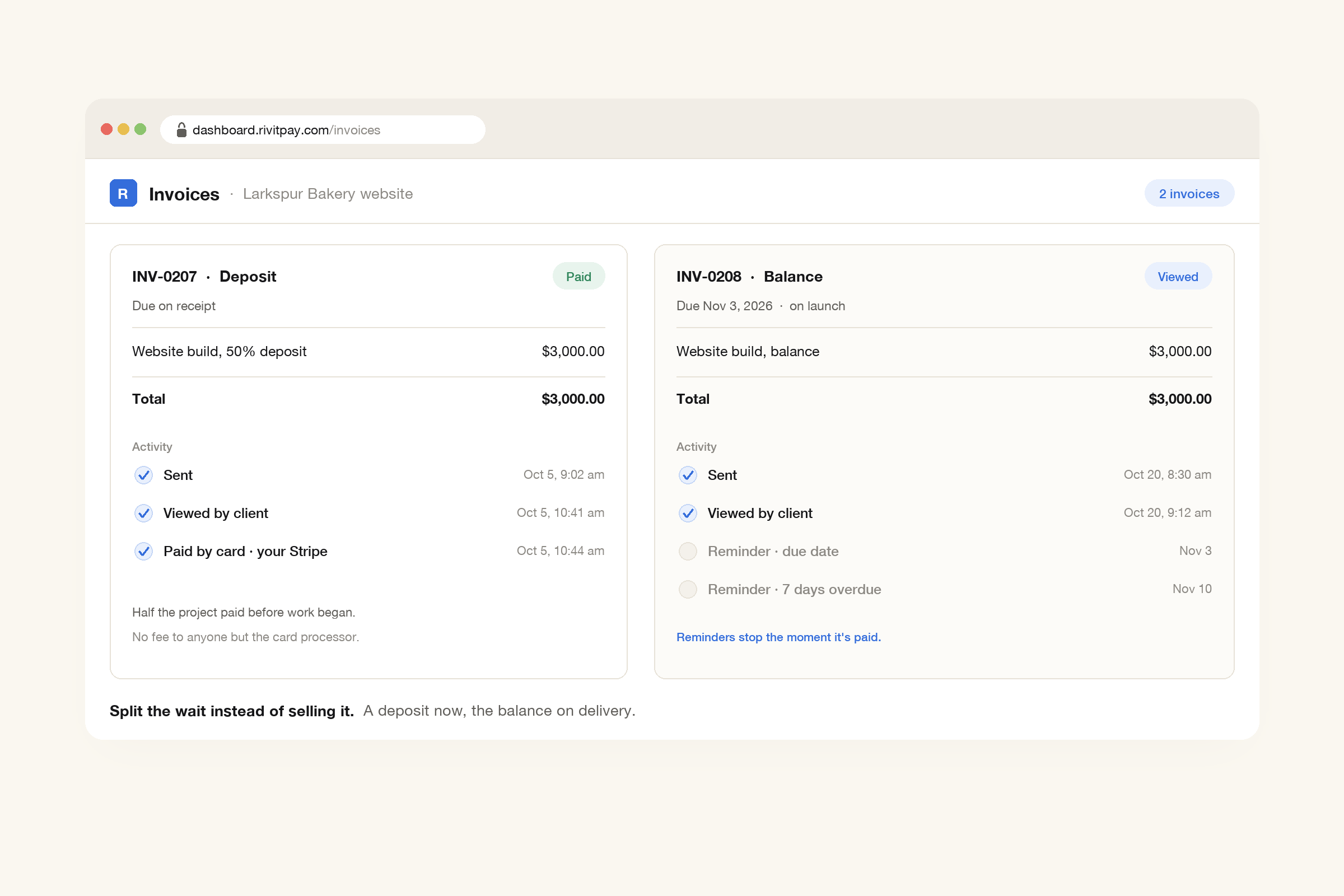
That's what RivitPay is built for. In a free account, a deposit and a balance are just two invoices. Duplicate the first, change the line and the due date, and send. Each goes out by email with the PDF attached and a Pay button, so your client pays by card or bank and the money settles into your own Stripe account. You can see when an invoice was sent and opened, and automatic reminders in your own words stop the moment it's paid. Invoicing is free, and there's no RivitPay fee until you've collected $5,000 through the Pay button. After that it's 1.5% plus Stripe's fees. Payment isn't the same as spendable cash, though, since Stripe's payouts take a few days. Here's how that timing works.
Price it like a loan, because it is one
Selling an invoice or taking a discount for early payment isn't shameful, and sometimes it's smart. Just put a yearly rate on it before you say yes. If the number makes you wince, ask for a deposit on the next job, shorten the terms, and make the invoice easy to pay. The cheapest early payment is the one nobody had to buy.
Deposits and balances in seconds, a Pay button into your own Stripe account, and reminders that stop when you're paid. Free until you've collected $5,000.
Make an invoice, free